The Challenge
When we set out to bring WarisanXR to Expo Osaka 2025, the brief was simple on paper: represent Malaysian cultural heritage at one of the world's largest international exhibitions. In practice, that meant solving a harder problem — how do you make a 600-year-old dance tradition feel immediate to a visitor who has never heard of Joget?
A static display wasn't going to cut it. Neither was a video screen. We wanted visitors to experience the dance, not observe it from a distance. The content had to carry real fidelity, and the delivery had to work for everyone at the Malaysia Pavilion, not just the tech-savvy minority willing to put on a headset.
What We Built
WarisanXR centers on a single piece of content: a Joget dancer captured in our studio using volumetric capture technology. Volumetric capture records a subject simultaneously from multiple angles, producing a true 3D representation. Not a flat video, not a 3D model, but a photorealistic holographic figure you can view from any angle, in full motion.
We placed the dancer on a physical pedestal at the pavilion. Visitors scan a QR code, point their phone at the image target on the pedestal, and the dancer appears, performing Joget right in front of them, in full fidelity. No app download. No headset. Just the camera already in their pocket.
The volumetric approach matters because it preserves originality. This is the actual performer, captured as she danced in the studio. Every movement, every detail of the costume. All of it preserved exactly as it happened. That's something traditional 3D animation simply cannot replicate.
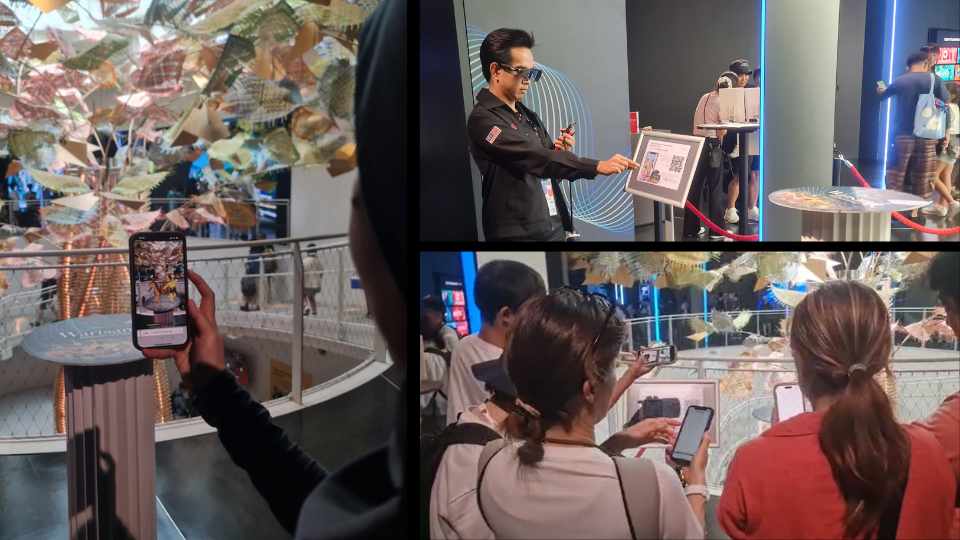
Visitors at the pedestal, scanning with their phones
The Pivot
We arrived at Expo Osaka with XReal Air 2 Ultra AR glasses. The passthrough experience on those devices is genuinely impressive. The hologram quality is a step above anything you can get on a mobile screen, and we had the content built to take full advantage of it.
Then we saw the crowd. The Malaysia Pavilion was drawing close to 20,000 visitors a day. There is no headset fleet that scales to that number, and even if there were, most visitors weren't going to stop and wait in line for a headset fitting at an expo.
We made the call on-site: switch to WebAR. Same volumetric content, same pedestal, different delivery. Every visitor's own phone became the viewer. The experience lost some of the visual fidelity of the glasses, but it gained something more important: it was accessible to everyone who walked past. That trade-off was the right one.
The Result
For one week during Kementerian Digital Week at Expo Osaka 2025, thousands of visitors, most of them Japanese, stood at our pedestal and watched a Malaysian dancer perform Joget in front of them.
A lot of them took photos. Many posed next to the hologram. Some came back for a second look. People chose to include the hologram in their own photographs. That tells you something about how the experience landed. It wasn't a passive display. It felt present enough that visitors wanted to be in the frame with it.
That's what cultural heritage technology should do: make something distant feel immediate. WarisanXR did that.
- Volumetric capture preserves authenticity. This is the real performer, real movement, captured as it happened. Animation cannot replicate that.
- WebAR removes the access barrier. Any smartphone becomes the viewer, no app or hardware required.
- The right delivery method depends on the environment. Know your audience and be ready to adapt on the ground.
Want to bring something like this to your next event?
We build volumetric hologram experiences for exhibitions, brand activations, and cultural institutions across Malaysia and internationally.
Get in TouchLearn more about our Mixed Reality services or explore our full portfolio.